

How to Become a Craniosacral Therapy Practitioner: Training, Certification & Career Guide
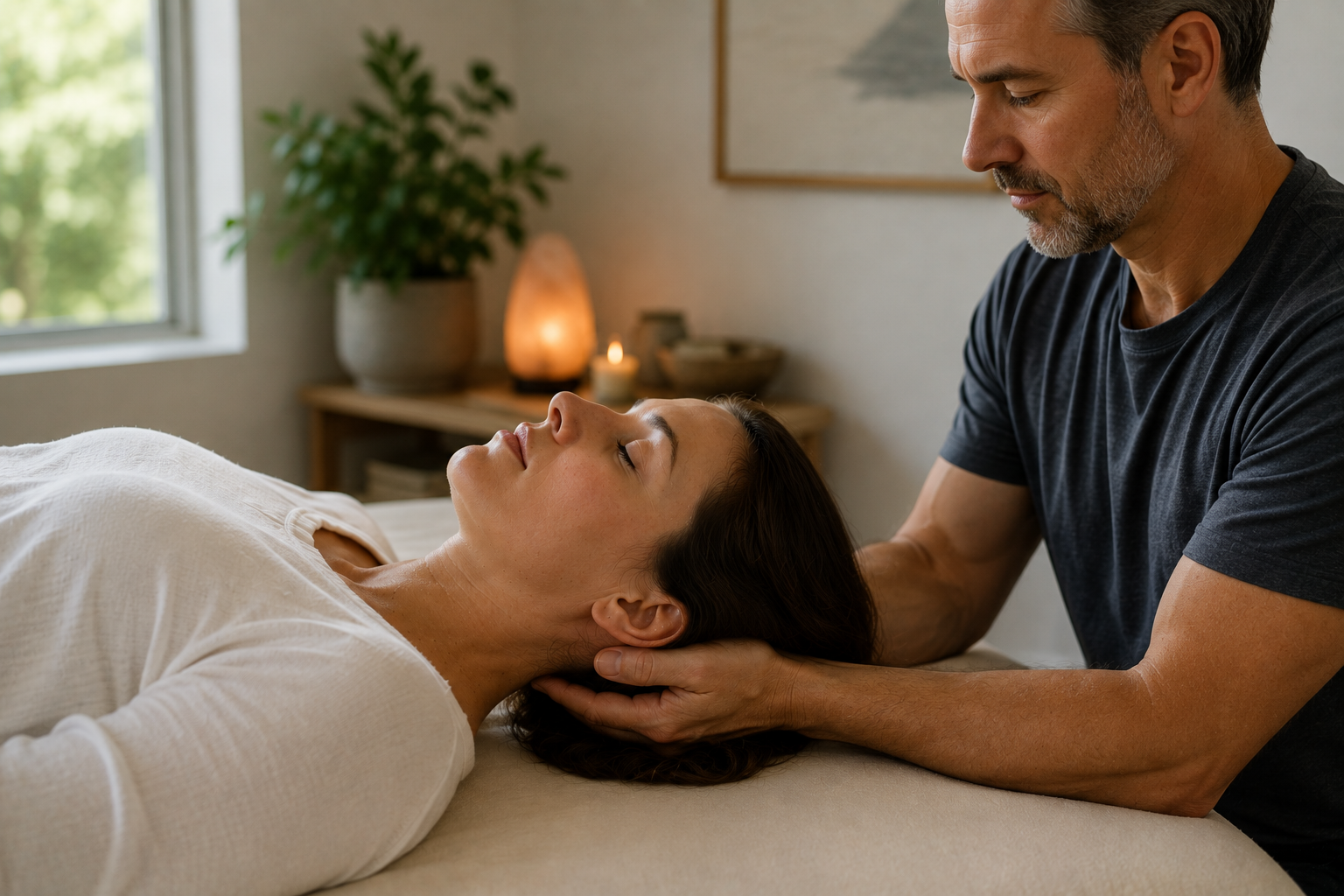
If you've ever received craniosacral therapy, or watched a skilled practitioner work, you've probably wondered how someone actually learns to do that. The stillness. The precision. The sense that something is happening beneath the surface of a touch that barely seems to move at all.
Maybe you're already a massage therapist looking for a modality that deepens the work you do. Maybe you're a healthcare or wellness professional exploring new hands-on skills. Or maybe you've just discovered craniosacral therapy and want to understand what real training involves before you commit to it.
Wherever you're starting from, the path isn't always obvious — and that's exactly what this guide is for.
Unlike professions with one national licensing exam, craniosacral therapy (CST) education varies widely from school to school. You'll find weekend workshops, multi-level certification tracks, online craniosacral therapy courses, and everything in between. Understanding those differences is the first real step toward becoming a craniosacral therapy practitioner.
What Is Craniosacral Therapy?
Craniosacral therapy is a gentle, hands-on bodywork approach built on light touch and focused palpation. Training centers on the anatomy of the cranium, sacrum, membranes, and fascia, alongside the practitioner's own developing ability to sense subtle movement and tissue response.
What surprises most new students isn't the anatomy — it's how much attention gets placed on their hands.
This isn't a modality built on force. Students learn to slow down, listen through touch, and notice small shifts instead of trying to create change through pressure. For massage therapists and experienced bodyworkers, that's often a real shift in thinking. Developing a lighter touch can take more skill, patience, and attention than applying more of it ever did.
What Does a Craniosacral Therapy Practitioner Actually Do?
A trained CST practitioner uses gentle, hands-on techniques within the boundaries of their professional education and legal scope of practice. Depending on their underlying profession, craniosacral therapy might be offered as its own service or folded into an existing bodywork or wellness session.
You'll find CST practitioners working in:
Massage and bodywork practices
Wellness and holistic health practices
Chiropractic offices
Integrative healthcare settings
Physical or occupational therapy clinics
Private practice
Multidisciplinary wellness centers
How you're able to describe and offer your services depends entirely on your existing credentials and the laws of the state you practice in. That distinction matters more than most new students realize — completing a craniosacral therapy training program does not, by itself, grant you a professional license to provide hands-on services.
How Do You Become a Craniosacral Therapy Practitioner?
There's no single national pathway every CST practitioner follows. Different schools and organizations have built their own educational models, requirements, and credentials. That said, the process generally comes down to four steps.
1. Determine Whether CST Fits Your Professional Path
Before choosing a program, get honest about how you plan to use the training. Are you a massage therapist adding CST to your existing sessions? An experienced bodyworker expanding your toolkit? A licensed healthcare professional exploring hands-on approaches? Or are you starting without an existing hands-on license?
Your answer matters, because being eligible to take a course and being legally permitted to provide a service are two different things. Before you enroll anywhere, research the scope-of-practice laws in the state where you intend to work.
2. Choose a Craniosacral Therapy Training Program
Look for education that goes beyond a checklist of hand positions. Strong craniosacral therapy training should help you understand both what you're doing and why. A well-built curriculum typically covers:
Relevant anatomy and physiology
Cranial and spinal structures, meninges, and fascia
Palpation skills and craniosacral rhythm
Stillness and listening skills
Foundational techniques and structured protocols
Professional boundaries, contraindications, and precautions
Client communication and ethical practice
Integration into an existing professional practice
The goal isn't memorizing where to place your hands. It's developing your ability to feel, observe within your scope, think critically, and work with intention.
3. Practice Your Palpation Skills
Reading about CST and understanding the anatomy behind it are essential, but intellectual knowledge alone doesn't build palpation. That only comes with repetition — practicing positioning, hand placement, pacing, and presence over time.
Think of your certificate as the beginning of your skill development, not the end of it. Your hands keep learning long after the coursework is finished.
4. Complete Your Program's Requirements
Certification requirements differ significantly from one school to the next. A program might require completed modules, supervised practice sessions, written assessments, practical demonstrations, case studies, or a final exam. There's no universal standard — which is exactly why you should ask any school you're considering what credential you'll actually receive, and what it takes to earn it.
What Does Craniosacral Therapy Certification Actually Mean?
This is one of the most important questions a prospective student can ask, because the word "certification" doesn't mean the same thing everywhere.
A school may issue its own certification after you complete its training and assessment requirements. Professional associations maintain their own, separate credentials — for example, the Registered Craniosacral Therapist (RCST®) designation through the Biodynamic Craniosacral Therapy Association of North America applies specifically to its approved training pathway, and shouldn't be confused with other forms of CST certification.
So instead of asking only "Will I be certified?" — ask "Certified by whom, after completing what, and what does that certification actually represent?" That question will tell you far more than a badge on a website ever could.
It's also worth being clear-eyed about what certification isn't: it's proof you completed a specific educational program, not a state-issued healthcare, massage therapy, or bodywork license. Whether hands-on CST services fall under massage therapy law, healthcare licensing law, or a state exemption varies by location, so confirm applicable rules with your state licensing board before offering it professionally. Your school teaches you the modality — your state determines what you're permitted to do with it.
Do You Have to Be a Massage Therapist to Learn Craniosacral Therapy?
Not always. CST practitioners come from massage therapy, physical therapy, occupational therapy, chiropractic, nursing, and other healthcare and wellness backgrounds. Some programs restrict enrollment to licensed professionals; others accept a broader range of qualified practitioners. If you're unsure whether you qualify, ask your training provider directly about its prerequisites and check them against your state's requirements.
What Should You Look for in a Craniosacral Therapy Training Program?
It's tempting to compare programs on price and how quickly you can finish. Look deeper than that. A program worth your time and tuition should offer:
A clear curriculum. You should know exactly what you're going to learn before you enroll — not discover it module by module.
Real anatomy education. Technique without understanding has limits. You should learn the structures behind the work, not just a sequence of movements.
Palpation development. CST lives and dies on touch perception. Training should teach you how to build that sense, not just present a list of hand positions.
Technique and application. You should understand how techniques connect and how an actual session is structured. At New England Bodywork & Wellness Academy (NEBWA), CST education includes foundational anatomy, palpation training, recognition of craniosacral rhythm, foundational techniques, and structured protocol work — built to give you the "why" alongside the "how."
Safety, ethics, and scope. You should finish with a clear understanding of your boundaries, contraindications, client communication, and when something falls outside your professional lane.
Meaningful assessment. If a program awards certification, ask what you actually have to do to earn it. There should be a real process behind the credential — not just a completed video playlist.
Can You Learn Craniosacral Therapy Online?
Yes — and for many practitioners, online craniosacral therapy training makes professional education far more accessible. But there's an important distinction: watching a technique is not the same as developing the hands-on competency to perform it well.
A well-designed online CST program should offer more than a library of demonstration videos. Look for structured education, clear technique instruction, anatomy lessons, guided practice expectations, and a real way to demonstrate your understanding. Online training tends to work especially well for practitioners who already understand professional touch, positioning, and basic bodywork principles — and it comes with a practical advantage traditional workshops don't: you can pause, replay, and revisit lessons as your skills develop, long after the first time you watched them.
Online vs. In-Person Craniosacral Therapy Training
Neither format is automatically the right one. In-person training gives you immediate hands-on partner practice and direct instructor feedback in the room. Online training gives you flexibility, accessibility, and the ability to return to material as many times as you need.
Consider your existing professional experience, learning style, schedule, access to in-person programs, and how much instructor feedback you personally need. An experienced bodyworker who learns well independently may thrive in a self-paced format. Someone newer to hands-on work might benefit more from being physically present in a classroom.
The real question isn't "which is better?" — it's "which environment will actually let me understand, practice, and integrate this work?"
How Long Does Craniosacral Therapy Certification Take?
There's no single answer. CST education ranges from short introductory workshops to extensive programs requiring hundreds of hours, and some professional associations maintain multi-year training standards for their proprietary credentials. More hours don't automatically make one model right for every student — and a shorter program shouldn't be mistaken for something it isn't. Compare programs on purpose, depth, prerequisites, curriculum, and assessment, not just the number of weeks on the syllabus.
How Much Does Craniosacral Therapy Training Cost?
Instead of comparing tuition alone, look at what the tuition includes. Ask how much content is covered, whether the course is introductory or comprehensive, whether there's a real assessment, whether practice requirements are built in, whether you keep access to the materials, and what credential you actually walk away with. A lower price isn't automatically a better value if it doesn't deliver the education you need — and a higher price should be able to clearly justify itself.
What Can You Do With Craniosacral Therapy Training?
For qualified professionals, CST becomes another tool in a broader professional toolkit. A massage therapist might weave craniosacral techniques into existing sessions. Another practitioner might build a practice with a stronger CST focus. Many go on to pursue additional advanced education after their foundational training.
Beyond the technique itself, CST tends to change how practitioners approach touch in general — learning to slow down, listen, and use less force often reshapes the way bodyworkers show up in every modality they practice. Your ability to advertise or provide these services professionally, though, still depends on your underlying credentials and your state's laws.
Craniosacral Therapy Training at New England Bodywork & Wellness Academy
At NEBWA, our approach to craniosacral therapy education is built to give practitioners more than a collection of techniques — we want you to understand the work, not just perform it.
Our CST curriculum covers foundational craniosacral anatomy, palpation development, craniosacral rhythm, structured techniques and protocols, and professional integration, with real opportunities to build sensitivity through your hands as you go.
NEBWA is an independent professional development academy serving qualified bodyworkers and wellness professionals. Our programs are educational training programs, not state licensure programs — students are responsible for confirming that any modality they intend to offer falls within their license, credentials, and applicable scope of practice.
Prefer to Learn Craniosacral Therapy Online?
NEBWA also offers a self-paced Craniosacral Therapy Certification program for practitioners who want structured, in-depth CST education without rearranging their life around travel and multi-day workshops. You'll move through the curriculum at your own pace, revisit lessons and demonstrations as your skills develop, and complete the program requirements for certification through New England Bodywork & Wellness Academy — all from home.
Explore NEBWA's Online Craniosacral Therapy Certification Program →
Learn at your own pace. Develop your hands. Deepen your understanding. Build a skill you'll keep refining for the rest of your career.
Frequently Asked Questions About Becoming a Craniosacral Therapy Practitioner
How do I become a craniosacral therapy practitioner?
Research the professional requirements in the state where you intend to practice, choose a CST training program that fits your credentials and goals, then complete the coursework, practice requirements, and assessments it requires.
Do you need a license to practice craniosacral therapy?
There's no single nationwide answer — requirements vary by state and often depend on how the service is provided and the practitioner's underlying profession. A CST certification alone doesn't grant legal authority to perform professional hands-on services.
Do you have to be a massage therapist to learn craniosacral therapy?
No. CST students come from massage therapy, physical therapy, occupational therapy, chiropractic, nursing, and other wellness or healthcare backgrounds, though some programs do restrict enrollment to licensed professionals.
Can you get craniosacral therapy certification online?
Yes. Online CST programs, including NEBWA's self-paced Craniosacral Therapy Certification, are widely available — when comparing them, evaluate curriculum depth and how competency is actually assessed, not just video count.
How long does craniosacral therapy certification take?
There's no universal timeline. Programs range from focused certification courses to multi-year training pathways, so compare the actual curriculum and credential awarded rather than assuming every program represents the same amount of training.
Is craniosacral therapy certification the same as a professional license?
No. A CST certification documents completion of a training or assessment process — it doesn't replace a massage therapy, healthcare, or other professional license where one is legally required.
Can massage therapists add craniosacral therapy to their practice?
Many do. Whether and how a massage therapist can advertise or provide it professionally depends on the scope-of-practice laws where they work.
What should I look for in a craniosacral therapy certification program?
A clearly defined curriculum, real anatomy education, palpation development, technique instruction, professional ethics and scope training, built-in practice opportunities, and clearly explained certification requirements.
Is online craniosacral therapy training worth it?
For the right learner, yes. It offers flexibility and repeated access to demonstrations — particularly valuable for practitioners who already understand professional touch and basic bodywork principles.
Where can I take craniosacral therapy certification online?
New England Bodywork & Wellness Academy offers a self-paced online Craniosacral Therapy Certification program for qualified practitioners who want structured CST education with the flexibility to learn from home.